
MX5000 Multi-Stage Pump Application
Pump Reliability and Condition Monitoring
Overview
Pumps are among the most critical rotating machines in process industries, including power generation, oil and gas, refining, chemical, and water treatment. Their role is to transport fluids under pressure to sustain continuous production and ensure system efficiency. Because they are often part of a larger, interdependent network of rotating equipment, their reliability directly affects plant throughput and operational safety.
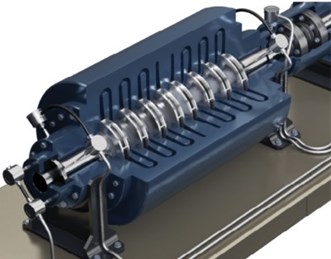
Most large multi-stage industrial pumps utilize fluid film bearings, which depend on a continuous oil film to support the shaft and minimize metal-to-metal contact. These are typically rugged machines, and with proper lubrication, balancing and alignment, should provide years of service.
Malfunctions
Unbalance
Occurs when the mass centerline does not coincide with the rotational centerline, leading to cyclic vibration. Unbalance often results from impeller fouling, erosion, corrosion or improper assembly during maintenance.
Misalignment
Results when the shaft centerlines of the driver and driven machine are not colinear. This condition generates axial and radial vibration, often accelerating bearing wear and coupling fatigue.
Rotor to Stator Rubs
Develops when clearances are insufficient or rotor orbit increases due to instability or unbalance. This contact can produce sudden vibration spikes, increased temperature, and potential seal damage.
Fluid-Induced Instabilities
Phenomena such as oil whirl or whip can occur when the fluid film within bearings or seals becomes dynamically unstable. The result is sub-synchronous vibration, circular orbit shape, and a rotor operating on the modified natural frequency of the system leading to rotor instability.
Shaft Crack
If a rotor is cracked, it most certainly will be bowed and will therefore change the 1X signature. A propagating crack reduces the stiffness of the rotor system, altering the resonant frequency, producing vibration signatures that vary with load and speed. Early detection prevents catastrophic rotor failure.
Motor Defects
Electrical problems such as broken rotor bars, smeared laminations, eccentric rotor, all result in unbalanced magnetic pull which is manifested as vibration and current signature anomalies.
Instrumentation
Instrumentation provides early warning of the above listed malfunctions through vibration monitoring, temperature sensing, and process parameter tracking. The following vibration sensors are recommended:
Vibration Sensors (Proximity Probes, Accelerometers, Velocity Sensors)
Detect changes in amplitude and frequency that indicate unbalance, misalignment, or rubs. Proximity probes allow measurement of shaft orbits, phase angles, and dynamic motion.
Temperature Sensors
Monitor bearing and seal temperatures to identify lubrication issues or frictional heating due to rubs or misalignment.
Motor Current Sensors
Helps identify electrical defects, torque variations, and load imbalances.
Pressure and Flow Monitoring
Helps detect hydraulic instabilities or cavitation that may lead to fluid-induced vibration.
Modern systems integrate these signals into predictive analytics platforms, allowing operators to trend data, detect deviations, and plan interventions before failure occurs.
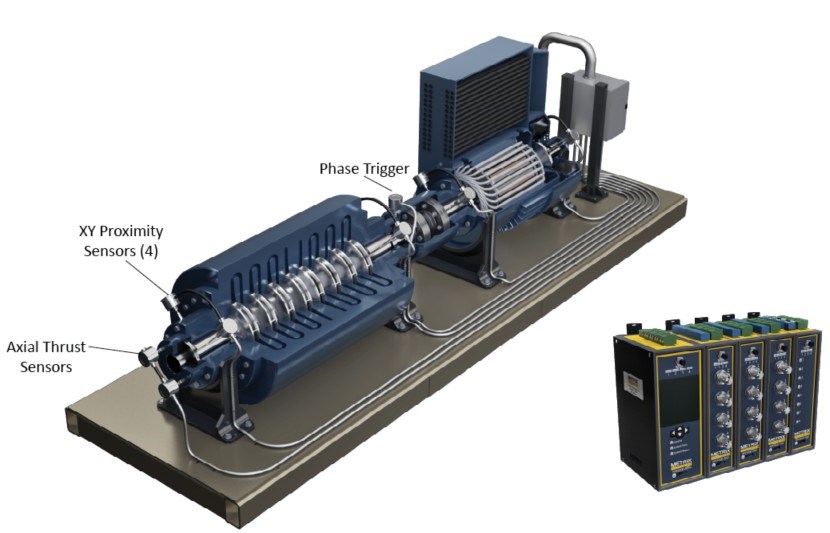
Most large multi-stage pumps utilize fluid film bearings. Due to the critical nature of these machines, Metrix recommends proximity probes mounted in an XY fashion to monitor each radial bearing, two thrust sensors monitoring axial position and a phase trigger to monitor speed and phase angle. We also recommend temperature monitoring at each bearing and stator temperature monitoring of the motor. Like in the picture below:
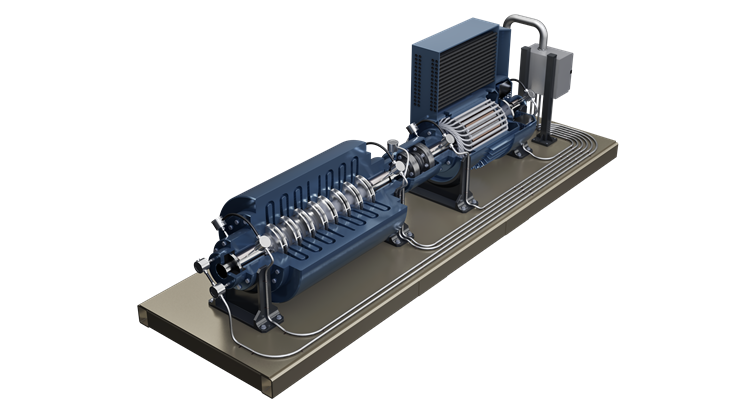 Critical Multi-Stage Pump
The MX5000 is ideally setup to monitor these types of critical machines. This 11 measurement system along with 6 temperature sensors can be easily integrated into the plant information system to correlate with input and output pressure, temperature and flow. This provides a complete picture of what’s happening with this machine during operation. This will give the user of the machine ample opportunity to detect abnormal issues before any significant damage can be done. This also provides the opportunity to plan maintenance when appropriate and necessary. This helps prevent unscheduled downtime, process interruptions, improves personnel safety, and saves you money. Below is a typical monitoring system for this four bearing machine:
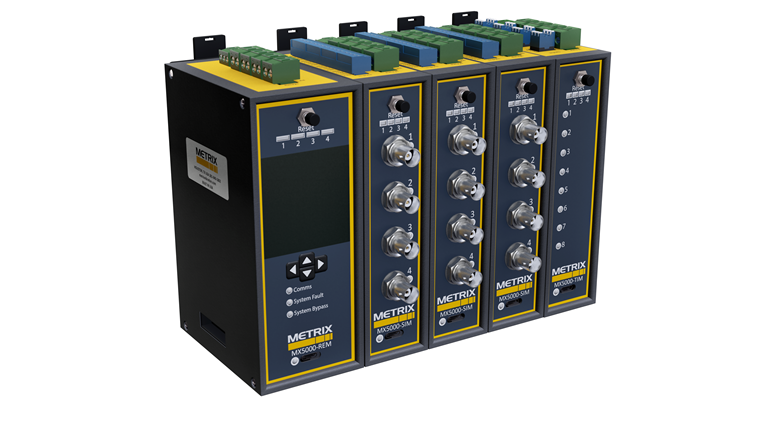 Typical MX5000 Monitoring System
The heart of the MX5000 is the Sensor Interface Module (SIM). Each SIM is a four channel monitor that can be plugged together to create a monitoring system. The Rack Emulation Module (REM) provides the necessary rack features to meet the requirements of API 670, namely, four mechanical relays, rack bypass, reset and trip multiply, as well as many other rack features. The Temperature Interface Module (TIM) is an eight channel monitoring system that can be combined with a REM and SIM modules to complete a critical machine rack. Both the SIM and TIM can stand alone and have four solid state relays each, 4-20 mA outputs for each channel, and a ModBus output for communications.
Case History
Refinery Example
A large oil transfer pump was returned to service following a scheduled overhaul. Shortly after startup, vibration amplitude exceeded alarm thresholds. Analysis of orbit plots, spectrum data, and startup and shutdown plots revealed a strong 1× running speed component without a change in resonant frequency, which is consistent with high unbalance. Phase measurements confirmed a consistent phase across bearings, indicating mechanical unbalance rather than misalignment.

Subsequent inspection found that the impeller had been installed 180° out of its balanced orientation. Once corrected and the rotor rebalanced, vibration returned to normal. The prompt detection prevented seal damage and avoided unplanned downtime. This possible pump outage could have reduced refinery throughput by 100,000 barrels per day. At a $5 per barrel margin, the loss is $500,000 per day—not including restart and safety costs.
Power Plant Examples
The impact of pump reliability is substantial. A single failed pump can reduce capacity and result in penalties for the utility.

A boiler feedwater pump failure may force a 600-MW unit offline. At $40 per MW-hr of wholesale power, one day of downtime equates to over $575,000 in lost generation revenue.
Gas Pipeline Example
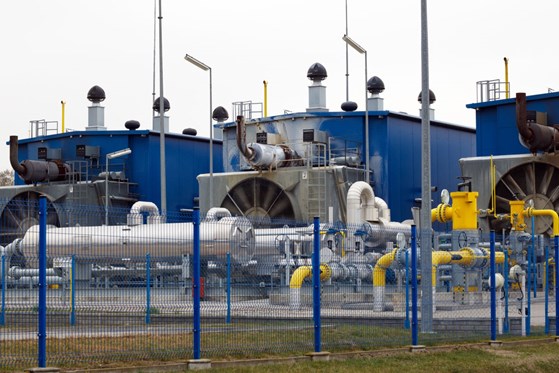
A mainline compressor station failure reduces flow capacity, potentially leading to contractual penalties or deferred deliveries worth tens of thousands of dollars per hour.
Assuming that predictive monitoring prevents even one day of downtime in three years, the investment in vibration monitoring instrumentation delivers a rapid and measurable payback, often within the first incident avoided.
Critical Motor Driven Pump
Minimal Recommended Sensor Suite: MX5000 Includes:
• 8 XY Radial Vibration Sensors (Proximity) • One Rack Emulation Module (REM)
• 2 Axial Thrust Sensors (Proximity) • Three Sensor Interface Modules (SIM)
• 1 Phase Trigger Sensor (Proximity) • One Temperature Interface Module (TIM)
• 6 Temperature Sensors (TC or RTD)
Metrix offers a wide range of industrial monitoring systems to meet your needs. To learn more about condition-based monitoring and real-time protection, please contact us today. Please call +1 281.940.1802, email info@metrixvibration.com, or visit our website at metrixvibration.com.