
Detection of Reverse Rotation, Low Speed and Stopped Conditions in Rotating Machinery
Overview
Reverse rotation is an often-overlooked operating condition that can affect pumps and other machinery. Metrix has created a system that can detect reverse rotation and can also confirm that a machine is at zero speed vs low speeds down to 1 RPM. This system can be used on pumps, compressors, turbines, and other rotating machinery across a wide range of industries.
Unlike normal operation, reverse rotation is typically driven by process forces rather than the prime mover, making it difficult to detect using conventional speed or vibration measurements. In many documented failures, equipment damage occurs after shutdown when operators assume the machine is no longer moving.
This whitepaper examines in further detail:
- How and why reverse rotation occurs
- Common causes across various industries, including low speed and stopped conditions
- Mechanical risks associated with low-speed movement
- Why traditional monitoring often misses detection of reverse rotation and low speed movement
- How modern monitoring systems detect reverse rotation and low speed reliably
- Benefits of reverse rotation and low speed detection, including stopped, across industries
- How reverse rotation detection works in practice using the Metrix 5580/SW5580
What is Reverse Rotation?
In many industrial applications, turbomachinery such as pumps are designed to operate in a single, defined rotational direction. Deviations from this intended direction result in reverse rotation.
The reverse rotation phenomenon occurs when a rotating machine turns opposite its intended direction due to external energy sources within the process system. Rather than being driven by an electric motor or turbine, the shaft is forced backward by fluid or gas flow, pressure equalization, or stored kinetic energy in connected piping and vessels.
What makes reverse rotation especially problematic is that it frequently occurs when machines are electrically stopped. Traditional monitoring schemes often assume that when a driver is de‑energized, the machine is at rest. In reality, the process can continue to act on the rotor, sometimes for extended periods, and in some cases accelerate the shaft in the reverse direction. Because this behavior occurs outside normal operating logic, it is often invisible unless rotational direction is explicitly measured.
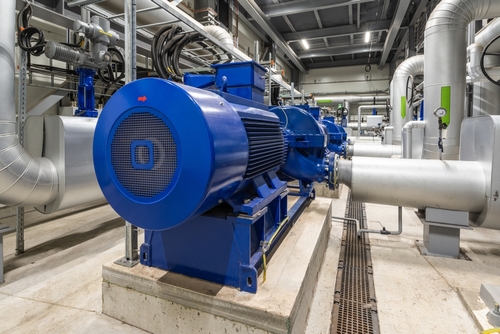
An industrial water pump at a power plant
Common Causes Across Various Industries
Pumps
In centrifugal and vertical pumps, reverse rotation is most commonly caused by backflow from discharge piping following shutdown. This can occur when check valves leak, stick, or close slowly, allowing pressurized fluid to flow backward through the pump. Parallel pump arrangements and common headers further increase the likelihood of this condition by introducing pressure imbalances between operating and non‑operating units.
During these events, fluid momentum drives the impeller backward, placing the shaft, thrust bearings, and seals under loading conditions for which they were not designed. If the pump is moving backwards, and then suddenly started, the momentum of the backward movement is against the normal forward rotation resulting in significant stress on the rotor shafts and coupling. Depending upon the rate of backward movement, the start-up stresses can result in machine damage such as sheared couplings (the coupling fails – it is normally designed to be the weak link in the system). This reverse motion often occurs at low speed, and it may not generate significant vibration and can remain undetected until damage has already occurred.
Compressors
Centrifugal and integrally‑geared compressors are susceptible to reverse rotation following trip or emergency shutdown events. Stored energy in downstream piping, inter‑stage volumes, or recycle loops can drive gas backward through the compressor, causing reverse rotation after coast‑down.
In many compressor designs, lubrication systems are reduced or shut off once a trip is detected. If reverse rotation occurs during this period, bearings and seals may be exposed to motion without adequate lubrication, significantly increasing wear. Several industry case studies have documented reverse rotation reaching thousands of RPM after shutdown.
Turbines
When large steam and gas turbines coast down after shutdown, they are still thermally hot. Due to their large size, they need to be placed on turning gear to prevent a rotor bow from occurring.
For this reason, being able to detect low RPM and stopped conditions are important in order to engage the turning gear. Slow speed and stopped detection are often included in speed monitoring systems for large steam and gas turbines.
Mechanical Consequences
Reverse rotation exposes machinery to operating conditions that fall outside the assumptions used in mechanical design. Bearings may experience loads from unintended directions, seals may operate outside their optimal lubrication regime, and rotors may pass through critical speeds that are normally irrelevant during forward operation.
Unlike steady state faults, reverse rotation damage is frequently cumulative and subtle at first. A pump or compressor may restart and appear to run normally, while hidden damage progresses over successive events. When failures eventually occur, they are often attributed to generic symptoms such as “bearing wear” or “seal failure,” masking the true underlying cause.
Why is Detection Often Missed by Traditional Monitoring Methods?
Most traditional machinery protection systems focus on speed magnitude and vibration amplitude. While these parameters are effective for detecting many faults, they generally assume the rotor is at a speed where the rotor can generate significant dynamic motion. Reverse rotation may not generate significant dynamic motion, and the typical monitoring system provides no information about rotation direction.
Speed measurements may simply report zero once rotational velocity falls below a threshold (e.g. 60 RPM), even if the shaft continues to rotate slowly in forward or reverse directions. Vibration measurements during reverse rotation are often low and non‑diagnostic, particularly in pumps and compressors operating without load.
As a result, reverse rotation can remain completely undetected until physical damage occurs. The solution is to treat direction as an independent, measurable condition.
Reverse Rotation as a Measurable Condition
Modern monitoring strategies treat direction as a first‑class measurement, not an inference.
Industry‑standard practices include:
- Detecting Forward, Reverse, and Stopped states explicitly
- Allowing alarms or relays to be active under specific direction conditions
- Using direction status in startup permissive logic
This enables machines to be protected not only while running, but also during coast‑down, shutdown, and restart.
Industry Applications and Benefits
Key benefits of reverse rotation, low speed and stopped detection include:
- Prevention of seal and bearing damage
- Improved startup/shutdown safety
- Reduced unexpected failures
- Enhanced root cause analysis
- Stronger alignment between process control and machinery protection
These benefits are why reverse rotation, low speed and stopped condition detection are widely adopted in the following rotating machinery:
- Boiler feedwater pumps
- Condensate pumps
- Circulating water pumps
- Pumps used in water and wastewater treatment
- Process and vertical pumps
- Centrifugal compressors
- Large steam and gas turbines
- Other rotating machinery
How Detection of Reverse Rotation, Low Speed & Stopped Conditions Works in Practice with the Metrix 5580/SW5580
Metrix has developed a compact monitoring solution capable of detecting reverse rotation, low speed and stopped conditions in rotating machinery. Reverse rotation is typically the result of process issues such as incorrect valve line-up or a malfunctioning check valve, whereas low speed and stopped conditions are normal conditions for rotating machinery.
The primary purpose of this system is to prevent machine startup under reverse rotation conditions, which can lead to severe mechanical stress and potential damage to couplings, shafts, and other drivetrain components. It can also be used to detect low speed and stopped conditions.
The underlying principle of the system is based on phase analysis. Two proximity probes are installed to monitor a once-per-turn (OPT) feature, such as a notch or projection on the rotating shaft. These probes are positioned with a known angular separation (between 60° and 120°), typically 90°. As the shaft rotates, each probe detects the passing notch and generates a corresponding signal. By comparing the phase relationship between these two signals, the system determines the direction of rotation as well as the time of rotation. A phase lead or lag between the probes indicates whether the shaft is rotating in the forward or reverse direction. No pulses from either probe for 60 seconds indicate the rotor is stopped.
Metrix 5580/SW5580 Solution
This approach is implemented with the Metrix SW5580 two-channel monitoring system. This simultaneously provides both speed and directional information.
- Channel 1: The first channel is dedicated to speed measurement, whether forward or reverse, reporting rotational velocity as a scaled 4–20 mA output. With a configurable full-scale range up to 4000 RPM, the system maintains high sensitivity and is capable of detecting extremely low-speed conditions to 1 RPM.
- Channel 2: The second channel communicates shaft condition using a separate 4–20 mA signal. Rather than representing a continuous variable, this output encodes discrete operating states. A reading of 4 mA (±0.2 mA) indicates normal forward rotation, while 8 mA (±0.2 mA) corresponds to a stopped condition, defined as the absence of pulse detection for more than 60 seconds. A value of 12 mA (±0.2 mA) signals reverse rotation.
This simple and robust signaling scheme allows seamless integration with distributed control systems (DCS) and other plant automation platforms.
System Configuration: It is intentionally straightforward, enabling rapid deployment in the field. During setup, users define the intended rotation direction—clockwise or counterclockwise—based on the perspective from the driver to the driven equipment. Additional parameters include the angular separation between the probes, the full-scale speed range, and alarm thresholds associated with reverse rotation. For example, an operator may configure an alert at 3 RPM reverse rotation and a danger level at 5 RPM. These thresholds provide graduated warning levels, supporting full preventive action and emergency response.
Feedback & Notifications: System notification is delivered through both analog and discrete outputs. The 4–20 mA signals provide continuous feedback to the control system, while relay-based contact closures enable immediate annunciation of alert and danger conditions. This dual-channel communication ensures that reverse rotation events are promptly identified and acted upon, even in complex process environments.
Conclusion
This whitepaper examined how reverse rotation occurs in pumps and compressors, and how low speed and stopped conditions impact large steam and gas turbines. The mechanical consequences associated with undetected reverse motion, as well as low speed and stopped conditions make direction detection an increasingly recognized best practice for modern rotating machinery monitoring.
To enable reverse rotation, low speed and stopped condition detection, we have expanded the monitoring capabilities of the 5580 Signal Conditioner and SW5580 Smart Switch. They can now provide clear, deterministic detection of hydraulic, mechanical, and operational issues, going well beyond traditional protection‑only measurements. These additional measurements enhance and complement monitoring systems used for early detection of imbalance, misalignment, looseness, and bearing degradation.
Together, these capabilities allow the Metrix 5580 / SW5580 to function both as a machinery protection solution and a condition monitoring tool, delivering clearer diagnostics, fewer nuisance alarms, and improved machine reliability.
If you’d like to discuss specific applications or configurations, please reach out to us, we’d be happy to help.