
MX5000 Monitoring for Cooling Towers
Cooling Tower Reliability and Condition Monitoring
Overview
Cooling towers are critical assets in power generation, petrochemical, refining, HVAC, water treatment, and industrial manufacturing facilities. Their function is to reject heat from process systems by transferring thermal energy to the atmosphere. Proper cooling tower operation ensures thermal efficiency, protects downstream equipment, and maintains overall plant reliability.
Cooling towers typically incorporate large fans driven by electric motors or gearboxes, mounted above or within tower structures. These assemblies operate continuously in harsh environments—high humidity, temperature extremes, corrosive atmospheres, with structural vibration exposure. Cooling towers directly influence condenser performance, process temperatures, and turbine efficiency; their reliability has a measurable impact on plant output and energy consumption.
Most cooling tower fans utilize rolling element bearings in motors and gearboxes, along with long drive shafts and couplings. Proper alignment, balance, lubrication, and structural integrity are essential to prevent premature failure. Continuous monitoring is key to ensuring long-term reliability and avoiding costly outages.
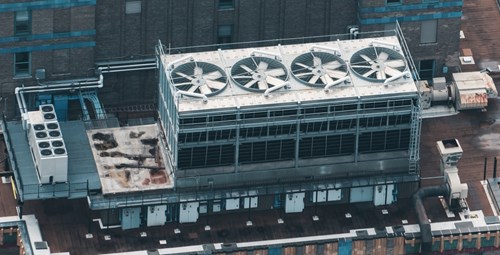
Figure 1: Four Cooling Tower Fans
What Malfunctions Can Occur In Cooling Tower Fans?
Unbalance
Unbalance in cooling tower fans often results from blade fouling, erosion, corrosion, ice buildup, or improper blade pitch adjustment. Fan diameters are large; even small mass deviations can generate significant vibration forces. Uncorrected unbalance leads to accelerated bearing wear, gearbox stress, and structural fatigue.
Misalignment
Misalignment between motor, gearbox, and fan shaft creates excessive axial and radial vibration. Over time, this condition contributes to coupling wear, bearing damage, and increased power consumption.
Gearbox Defects
Cooling tower gearboxes operate under constant load and are subject to wear, lubrication degradation, and gear tooth damage. Gear mesh defects generate characteristic vibration signatures at gear mesh frequencies and sidebands. Early detection prevents catastrophic gearbox failure.
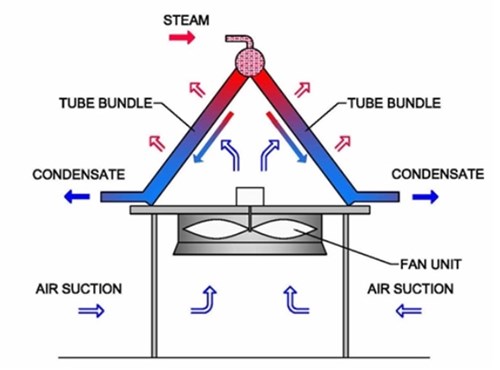
Figure 2: Dry Cooling Tower Fan
Bearing Defects
Rolling element bearings in motors, gearboxes, and fan shafts are exposed to moisture contamination and high loads. Defects such as inner race, outer race, ball, or cage damage produce high-frequency vibration and increasing temperature trends.
Structural Looseness
Cooling towers are often mounted on elevated steel or concrete structures. Loose hold-down bolts, degraded supports, or structural resonance can amplify vibration and accelerate fatigue cracking.
Electrical Motor Defects
Electrical issues such as rotor bar defects, eccentric air gaps, or phase imbalance generate unbalanced magnetic pull. These defects manifest as vibration and motor current anomalies and can contribute to premature bearing failure.
What Instrumentation Is Required for Condition Monitoring of Cooling Towers?
Instrumentation provides early warning of the malfunctions listed above through vibration monitoring, temperature sensing, and speed measurement. Modern monitoring systems integrate these signals into predictive analytics platforms, allowing operators to trend data, detect deviations, and schedule maintenance before failure occurs.
For cooling tower applications, the following sensors are recommended:
Vibration Sensors
Accelerometers detect high-frequency vibration associated with bearing and gear defects.
Velocity sensors are effective for monitoring overall vibration severity in accordance with ISO standards. Proximity probes may be used on large sleeve-bearing fan shafts to measure shaft displacement and phase. These sensors identify changes in amplitude and frequency that indicate unbalance, misalignment, looseness, and mechanical degradation.
Temperature Sensors
Temperature sensors installed on motor and gearbox bearings provide early indication of lubrication issues, overloading, or developing mechanical defects.
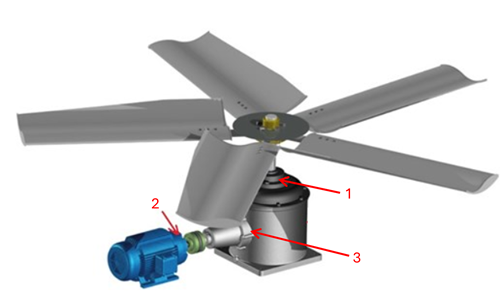
Figure 3: Dry Cooling Tower Fan (Gear Box-Driven)
Speed and Phase Sensors
A phase trigger or speed sensor enables accurate spectral analysis, phase measurement, and orbit analysis (where applicable). This allows differentiation between unbalance, misalignment, and looseness.
Motor Current Sensors
Motor current analysis can help identify electrical defects, torque variation, and loading anomalies caused by fan blade pitch problems or airflow restrictions.
Cooling Tower Fan Monitoring Recommendations
Cooling tower fans are often considered balance-of-plant equipment, yet their failure can impact operations. For most installations, the most important bearing is the fan bearing. The closer you get to monitoring the fan bearing, the better early warning you’ll have to identify mechanical faults.
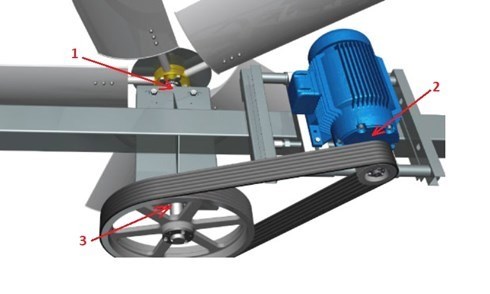
Figure 4: Dry Cooling Tower Fan (Belt-Driven)
Metrix recommends continuous monitoring in this priority:
- Fan shaft bearing (Position 1 as shown in Figures 3 and 4 above)
- Motor shaft bearing (Position 2 as shown in Figures 3 and 4 above)
- Gearbox input bearing (Position 3 as shown in Figure 3 above)
- Fan pulley bearing (Position 3 as shown in Figure 4 above)
- Structural vibration
Most customers use a vibration switch with possible 4-20 mA output on the fan structure. This is proven to be adequate monitoring, providing early warning if mechanical faults occur.
Due to high channel density, the MX5000 is ideally configured to monitor these types of machines using a velocity sensor on the fan bearing. Additional sensors can be added to cover the gearbox and motor if required. Its modular architecture allows flexible channel configuration to match the cooling tower’s complexity.
A complete sensor installation may include:
- Radial vibration monitoring on motor and gearbox bearings
- Accelerometers on gearbox housing for gear mesh detection
- Temperature inputs for motor and gearbox bearings
- A phase trigger for speed reference
Integration with plant control systems via Modbus and 4–20 mA outputs provides operators with a complete view of mechanical and operational health.
The MX5000 System
The heart of the MX5000 is the Sensor Interface Module (SIM), a four-channel monitor that can be combined to create a scalable monitoring system. The Rack Emulation Module (REM) provides API 670-compliant rack functionality, including mechanical relays, rack bypass, reset, and trip multiply features. The Temperature Interface Module (TIM) provides eight channels of temperature monitoring and can be combined with SIM and REM modules to create a comprehensive machine protection system.
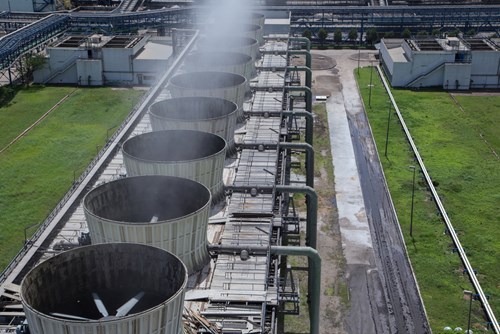
Figure 5: Cooling Tower Fans
Each SIM and TIM includes:
- Four solid-state relays
- Individual 4–20 mA outputs per channel
- Modbus communication capability
- The ability to stand alone as its own monitor
This flexible architecture allows the MX5000 to protect anything from a single cooling tower fan to multiple cells within a large facility.
Case Studies
150 Megawatt Combined Cycle Gas Fired Power Plant Example
In order for this power plant to operate, the critical equipment must be in good condition. For example, the Gas Turbine, the Steam Turbine, their associated generators, the Feed Pump, the condensate pumps, the cooling system, etc. all have to be in working order before operations can commence.
The margin on 1 megawatt-hour (MW-hr) of electricity is a minimum $45 USD / MW-hr, sold to wholesale customers (this is a $0.045 USD per kW-hr rate). So, one hour of unscheduled downtime equates to a Lost Opportunity Cost of $6750 (150 MW-hrs/hour x 1 hour x $45/MW-hr = $6750). One day of unscheduled downtime results in a Lost Opportunity Cost of $162,000 per day ($6760/hour x 24 hours = $162,000) Customer Value = Repair Cost + Unscheduled Downtime = + $162,000 minimum per day.
Note: Components within the combined cycle plant may be redundant or, if unavailable, may reduce plant capacity. This applies to the condensate pumps, cooling water pumps, cooling tower fans, etc., meaning they have less of a financial impact on the plant. For example, let’s assume that if a cooling tower fan is out of commission, the plant capacity is reduced by 5%. That would mean that the Customer Value is 5% of the values calculated above or $8,100 per day ($162,000/day x 5% = $8,100).
In other words, the Gas Turbine, the Steam Turbine, their associated generators, and the Feed Pump may easily justify Full Metrix Transducer Suite of Sensors (XY Bearing Vibration, Thrust, Speed, and/or Impact) with full integration to the Plant Information System, whereas the condensate pumps, cooling water pumps and cooling tower fans would justify the one or two Metrix transducers and the MX5000 integrated to the appropriate Control System and Plant Information Network.
Sensor solutions are so versatile now that power plants can easily use them in even the most out-of-the-way areas. This allows technicians to get the flexibility they need without having to put themselves in harm’s way to get the job done.
Refinery Example
A refinery cooling tower gearbox exhibited increasing high-frequency vibration and rising bearing temperatures. Bearing defect frequencies consistent with an outer race fault were observed.
Maintenance was scheduled during a planned outage. Inspection confirmed bearing spalling. The bearing was replaced before catastrophic failure occurred, preventing collateral gearbox damage and extended downtime.
Return on Investment
Assuming predictive monitoring prevents even one day of downtime in three years, the investment in vibration monitoring instrumentation delivers rapid and measurable payback—often during the first avoided incident.
Cooling tower failures can result in:
- Reduced thermal efficiency
- Increased energy consumption
- Forced derates
- Emergency maintenance costs
- Safety risks from structural damage
Continuous protection using the MX5000 ensures improved reliability, enhanced safety, and optimized plant performance.
Conclusion
Cooling towers are essential assets whose reliability directly impacts plant throughput and efficiency. They operate continuously in harsh environments, making proactive condition monitoring essential.
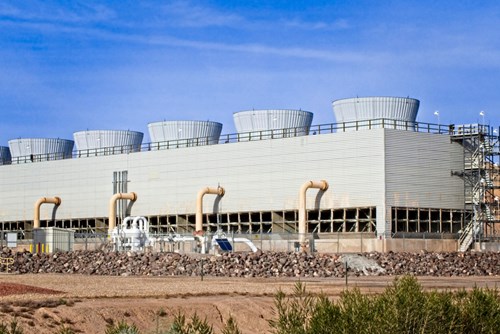
Figure 6: Cooling Tower with Five Fans
The MX5000 provides a flexible, modular, and robust monitoring solution for cooling tower fan systems. By integrating vibration, temperature, and speed measurements into a comprehensive protection platform, operators gain the insight needed to detect early-stage faults, prevent catastrophic failures, and protect plant profitability.

Download our MX5000 for Cooling Tower Applications Whitepaper