
Why Every Maintenance Team Needs a Handheld Vibration Meter: The Metrix VM3800A
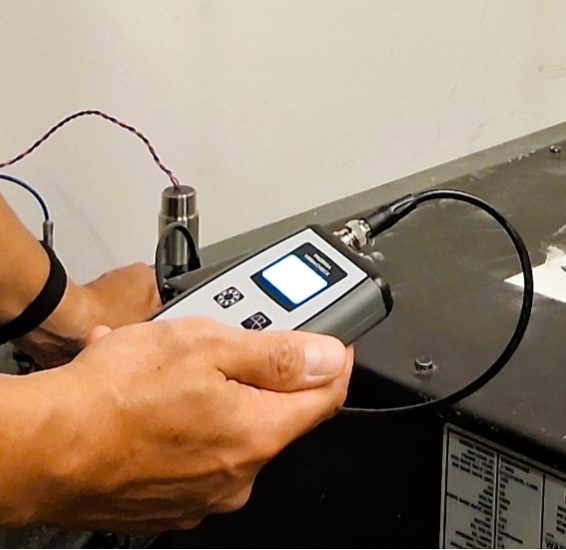
The VIBRA-CHECK® VM3800A Portable Vibration Meter in the field
Most rotating equipment doesn’t fail out of nowhere. It gives you hints—small changes in vibration that show up weeks or months before a serious problem like a bearing failure, or a coupling problem, becomes expensive. The challenge is catching those hints quickly, consistently, and in a way your team can act on.
That’s where a handheld vibration meter earns its keep. And when you pair that concept with a purpose-built tool like the Metrix VM3800A, you get a practical, “grab-and-go” approach to condition checks that fits real maintenance workflows—without requiring a full-time analyst or a permanently installed monitoring system on every asset.
Why handheld vibration meters still matter
Permanent online monitoring is ideal for critical assets, but most plants run a mix:
• A handful of critical machines that justify continuous monitoring going to a Vibration Monitoring System (VMS)
• A larger population of important-but-not-critical assets, typically called essential machines, that should have at least continuous monitoring vibration transmitters going to the Control System
• Many utility and auxiliary machines, typically called balance of plant machines, where “spot checks, done regularly” prevents most surprises
A handheld meter covers the essential and balance of plant machines. It’s the tool you can take to the field to answer:
• “Is this pump getting worse?”
• “Did that alignment job actually improve vibration?”
• “Which motor should we prioritize this week?”
• “Is the fan safe to keep running until the next outage window?”
A good handheld program turns vibration into something maintenance can use immediately: trendable numbers, quick comparisons, and repeatable checks.
What “utility” looks like in the real world
A handheld vibration meter delivers value when it helps you do one (or more) of these things consistently:
1. Fast screening across many assets
Instead of guessing which machine “sounds bad,” you can take quick measurements and sort the work by condition. The VM3800A supports the kind of route-style approach where you collect readings at defined points and compare them over time.
Practical payoff: fewer surprise failures and fewer unnecessary teardowns.
2. Confirming repairs and catching regressions
After a bearing change, alignment, or balancing job, you want proof the machine improved—and you want to know if it starts drifting again.
Practical payoff: better repair quality and faster feedback loops.
3. Establishing baseline condition
A baseline reading taken after commissioning or after a known-good repair becomes your “gold standard.” Later readings are instantly more meaningful because you’re comparing the machine to itself.
Practical payoff: trends become actionable early, before alarms are obvious.
4. Troubleshooting under pressure
When production calls with “We’ve got noise and heat on Pump 4,” you don’t want a long setup. You want quick, reliable measurements you can trust.
Practical payoff: faster decisions, less downtime.
How the Metrix VM3800A fits into a maintenance workflow
A handheld meter is only as useful as the habits it supports. The Metrix VM3800A is designed for exactly that: repeatable field measurements with minimal setup.
Here’s how teams typically use a tool like the VM3800A to build a strong, lightweight, vibration practice:
Route checks: “Measure, trend, act”
• Define measurement points (e.g., inboard/outboard bearings, horizontal/vertical/axial)
• Record readings on a schedule (weekly, biweekly, monthly depending on criticality)
• Trend results and flag machines that are changing
The result is a condition-based prioritization list that maintenance and operations both understand with very little out-of-pocket cost.
Exception checks: “Something changed—verify now”
When operators report a new sound, temperature rise, or process change, a quick VM3800A check helps confirm whether vibration is normal, elevated, or climbing.
Post-maintenance verification: “Did we actually fix it?”
A short “before and after” measurement takes the debate out of the room. If vibration isn’t improved after alignment or a bearing replacement, you can correct course immediately.
Where handheld vibration meters deliver the biggest ROI
You don’t need to instrument everything to get big wins. Plants typically see the fastest payoff when they focus handheld checks on:
• Centrifugal pumps (bearing wear, cavitation symptoms, unbalance)
• Fans/blowers (unbalance, looseness, belt issues)
• Motors and motor-driven packages
• Gearboxes (changes in vibration that hint at wear)
• Cooling tower equipment and auxiliary systems
• Spare machines (baseline after installation)
Rule of thumb: if an unexpected failure causes overtime, lost production, or safety risk—even if it’s “not critical”—it’s a candidate for a handheld check and continuous vibration monitoring using vibration transmitters back to the control system.
Best practices to get consistent, comparable readings
Handheld vibration programs fail for one reason more than any other: inconsistent measurements. To get reliable trends:
1. Measure the same point, the same way, every time
Use consistent locations and orientations (H/V/A) on each machine.
2. Use repeatable mounting
Variability in how the sensor contacts the machine can create variability in readings. A consistent technique, like a magnetically mounted sensor or physical quick connect mounting (stud mount), reduces “noise” in your trend data.
3. Record operating conditions
Load and speed matter. Readings taken at different speeds or different process conditions can look like “faults” when they’re just operational differences.
4. Trend machines against themselves first
Absolute limits matter, but the quickest insight comes from “What changed since last time?”
5. Create a simple escalation rule
For example:
• Small increase: recheck next route
• Moderate jump: recheck sooner + inspect
• Large jump: plan maintenance and corrective action
Handheld meter vs. online monitoring: it’s not either/or
A handheld vibration meter is often the most efficient first step:
• Use handheld measurements to screen and trend a wide asset base.
• Reserve continuous monitoring for critical assets, essential machines, and those balance of plant assets that are troublesome, or where access/safety makes handheld checks impractical.
• Move the worst balance of plant offenders to online monitoring using vibration transmitters going to the Control System.
This approach keeps reliability programs scalable, especially when staffing and budgets are tight.
The bottom line
A handheld vibration meter like the Metrix VM3800A is valuable because it turns “equipment intuition” into repeatable, trendable data—fast enough to use in the field and practical enough to run across many machines.
It’s one of the simplest ways to:
• Reduce unplanned downtime
• Validate repair quality
• Build a condition-based maintenance rhythm
• Catch developing issues early, before they become production events
If you’re looking for a high-impact reliability tool that fits the realities of day-to-day maintenance, a handheld vibration meter like the Metrix VM3800A, which also includes the ability to monitor temperature, is hard to beat. For more information, please contact us or your local Metrix representative - we would be happy to help!